Hello! This is the first “regular” newsletter I’m sending. I’m still figuring out what form this all is going to take, but I’m probably going to have a few running-but-irregularly-updated meditations on various things — which is just to say that there will be a Pt. 2 to this post, but probably not next week.
Literature is a Bonus Feature of the Book
Reading is very strange. The best account I’ve found of what it’s like comes from Samuel R. Delany’s Silent Interviews, in which he compares all acts of reading to that of reading an instruction manual. “We start. We stop. We look away…We backtrack and skip ahead and stop and start again. We skim. We think about other things. We decide we’d better concentrate more on the task,” and so on, until “our purpose is accomplished.” This “purpose” is part of what he’s getting at with the instruction manual metaphor: we always read for a purpose, even if our purpose is enjoyment. We put the book down when we decide we’ve achieved that purpose, “even if a tenth, or nine-tenths, of the manual demonstrably remains unread, an excess lingering among its pages.”
This excess is crucial. We always get more from reading than we came for, “if only because our eyes have brushed across a section heading or snagged, while we were turning pages, on some bit of boldface type.” He continues:
No matter how utilitarian we intended our trip through the text to be…we've always (already) gotten caught in some of the excess. We've ended up reading a little more than we had to in terms of our purpose. In precisely the same way that, vis-a-vis some ideal of mastery, we never read it all or read what we read really carefully enough, at the same time we've always read a little more than we needed to, a little extra, as though our purpose in reading was itself attacked, changed, revised, and rendered, for a while, unstable by consulting the manual at all.
(This section always puts me in mind of that great poem about not doing your homework, John Ashbery’s “The Instruction Manual.”)
Unlike some of Delany’s other “advice,” which makes me feel like I have wasted my life, I find this account calming: anxiety-reducing. I have had a lot of anxiety about the cognitive act of reading. In my early twenties, the strange inexhaustibility of reading—the fact that I could spend months thinking about each word of a sentence—so overwhelmed me that I had to go to therapy for it. Delany’s articulation of what reading is like, on the other hand, is both humble and exciting. You’re never going to get it all, but you’re going to get more than you came for, because there’s always something there you weren’t expecting. The intuition that we get when we feel inclined to dig into something, to root around, to investigate, is an intuition which parallels the aesthetic experience of reading. There’s something more there.
A Note on Detectives
The classic fictional figure who looks for “something more there” is, of course, the detective. Sherlock Holmes is a genius because he is able to perceive facts about the world which, properly concatenated, allow us to track back to an earlier state of affairs. The world of the detective is, in a real sense, enchanted: Holmes’s world glows with a kind of significance that it does not for, say, poor Watson. One of the pleasures of the Sherlock Holmes stories, and detective stories in general, is the feeling that we can vicariously participate in a world where small things—the condition of a person’s dress; a seemingly trivial utterance—can mean a great deal: can point us back to the truth. (The world is in excess of itself.) Augustine wrote that the phenomenal world is a trail of signs pointing back to God. Holmes’s chain of signs doesn’t go back quite that far—it doesn’t lead us to the Truth—but it can lead us to the truth. (Ultimately, in this sense, detective stories are very similar to what people who talk about video games call “environmental storytelling.” But more on that later.)

This picture came up when I searched “Watson Detective” so I’m assuming it’s canonical
Part of the reason Holmes’s company is so addictive (for Watson as for the Arthur Conan Doyle-liker) is because this mode of perception, this sense that there’s something more there, feels good. It’s this feeling, I think, that leads us to stick with “difficult” art: maybe we can dimly perceive the presence of something there, maybe someone we trust told us there’s something there, but we feel like, underneath the surface, there’s something there, and we want to get to the bottom of it. We see the surface and we think it’s hiding something.
There are lots of stories in which this sense, this feeling that there’s something to know, leads people down a bad way—Oedipus is the classic “anti-investigative” figure, in this sense, at least if we stop reading at the end of Oedipus Rex. (Oedipus at Colonus, the third volume of the trilogy, casts his fate in a very different light, but people seem to prefer the gloomier “never know a man happy until he’s dead” ending.) The detective, on the other hand (and as Roberto Bolaño understood), is a passionately optimistic figure: someone like Sherlock Holmes allows us to feel not only that the world means more than we thought it did, but that this meaning can serve the end of justice.
On the Idea of Lore
Two examples that come to mind for me of “lore-heavy” art are Gene Wolfe’s Book of the New Sun and the Souls series of video games. Aesthetically speaking, these have a lot of similarities (a world comprised seemingly solely of gigantic goth ruins, lots of walking, dark cloaks, etc.); perhaps most relevantly for our purposes, both take place in worlds well past their primes, built atop a foundation of mysterious, semi-functioning artifacts. (This helps explain the prominent presence of solar cults in both works: these are worlds which once contained a lot more light and energy than they now do.) In both Book of the New Sun and Dark Souls (we’ll stick with the first game for now), the protagonist is tasked with renewing a dying world.
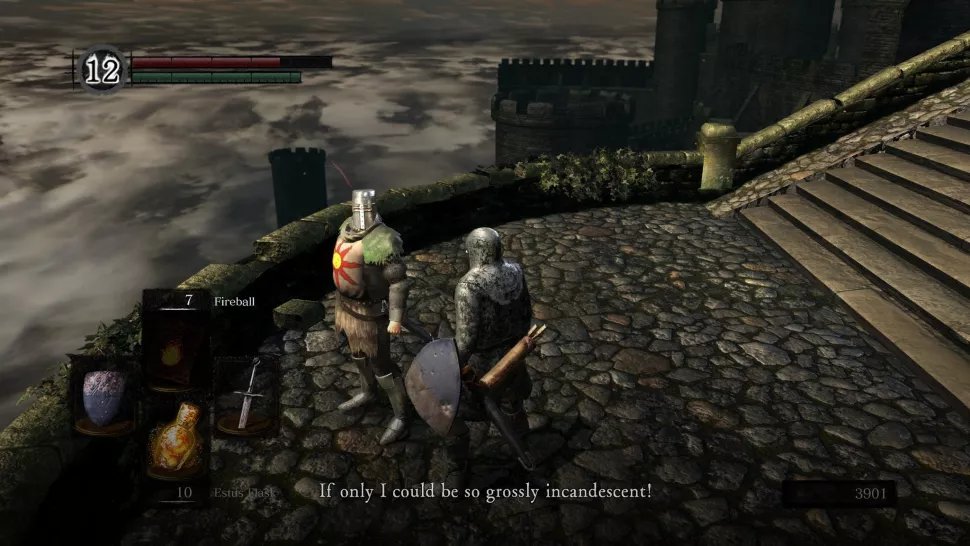
For a nice book about being grossly incandescent, why not check out Urth of the New Sun (Solar Cycle #5)
In these worlds, it’s hard to understand what everything means. My first time through both Dark Souls and Book of the New Sun, I had almost no idea what was going on. There felt like a a logic connecting the disparate fragments I was given, but it was obscure—literally occult. In Dark Souls, nobody gives it to you straight: NPCs speak cryptically, gnomically, often doing more to confuse than to elucidate. The great explainer of the game, Kingseeker Frampt, is a gigantic dinosaur-looking guy that appears partway through the game in a little pond by your home-base; if you dig around a bit, you can learn that he, too, has an agenda.
Or, in Book of the New Sun, the physical landscape of is at least Stonehenge-level mysterious, but instead of big rocks, it’s giant spaceship husks and poisonous alien plants and enormous genetically modified horses with claws. (The first really awe-inspiring submerged reality of Book of the New Sun’s physical environment, in my experience, is the fact that the enormous Citadel, the setting for the first seven chapters of the book, is actually a titanic, busted spacecraft.) But these environmental facts aren’t at all immediately apparent. It takes investigative work to understand what happened in these worlds, what they’re made of: physically, historically, socially. Crucial facts about context and setting are stashed away where you wouldn’t expect to find them, in item descriptions and secondary clauses. Take, for example, one of my favorite paragraphs from the first volume of Book of the New Sun, The Shadow of the Torturer:
Buried in a very long paragraph—at the precise point in that paragraph, I’d say, that the reader is most likely to miss something—are a couple of absolutely bonkers facts about the world, told not for their own sake, but in order to describe a character’s personality.
Neither Dark Souls nor Book of the New Sun (in my opinion) are obscure for obscurity’s sake. One of the pleasures of both Book of the New Sun and Dark Souls is the feeling that we, the readers and/or players, are discovering a world that has not been hitherto mapped. Dark Souls is a hard game to play in part because its mechanics participate in this difficulty: it is “unforgiving” because it is up to you to understand what is going on, and this understanding is elusive, but (its boosters claim) worth it. When it comes, finally, it feels hard-won, in the same way our understanding of the setting feels hard-won. Book of the New Sun and Dark Souls both trust the reader/player’s capacity to understand and interact with a strange world. (This is the thrust of the joke near the end of the Master Gurloes paragraph: Wolfe’s claim that the most obnoxious of his undead Latinate-isms are “common” is one part self-deprecating gag and one part gesture towards the trickiness of the task of the reader, who has been drafted into the subjectivity of one living in a world incredibly remote from our own.)
This is why, in my sojourns among online Solar Cycle dorks, I have seen so many people get hung up on what I think of as the hidden treasure dimension of lore-hunting. Is the woman from the Feast of St. Katherine really Severian’s mother? Is that opening scene with Vodalus actually set in the future? How many times does Severian die? These aren’t ungrounded questions, and they’re fun to think about; some of them lead fruitful places. But I think the important thing about the books is not their answers, but that they occur to us to ask.
To be continued...